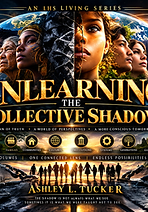
Each format has its own live Stripe link carrying this volume's cover. Book formats switch on when the volume passes its quality gate.
Opening
BEYOND THE SHADOW — Building a Future We Do Not Have to Unlearn. This is volume 36 of Unlearning the Collective Shadow™, act vi · unlearning and reconstruction. Naming the whole system, then building what comes after it.
What would this generation have to do so the next one has less to unlearn? The series does not answer that question for the reader. It supplies the record, names the pattern, sets out the competing explanations, and leaves the audit in the reader's hands.
Lifespan stage covered: legacy — and the future (all ages). Populations this volume speaks to: parents and caregivers; educators; institution builders; young people; communities. The series treats no population as homogeneous, and this volume states where its evidence is thin.
The Central Question
What would this generation have to do so the next one has less to unlearn?
Chapters
SHADOW· CHAPTER 1
The Shadow of Beyond the Shadow
the pattern that arrived before consent
The volume opens on the pattern itself, before it has a name: What would this generation have to do so the next one has less to unlearn? What is inherited here is not an opinion but a working assumption — an arrangement of the household, the school or the workplace that the child, worker or citizen never agreed to. The record this rests on: Documented policy reforms that reduced inherited harm and their measured aftermath.. The LHS reading offered at this point is a reading, not a finding — it stands or falls on whether the evidence in this volume supports it, and the competing explanations are set out in full later.
What this volume claims at this step, and what would falsify it.
Which competing explanation — individual choice, material pressure, institutional design or cohort effect — best fits the evidence at this step.
Documented anchor for this chapter: Documented policy reforms that reduced inherited harm and their measured aftermath.
LHS interpretation at this step: the pattern is described as inherited rather than chosen. This is an LHS reading, offered for examination, and is not presented as an established finding.
SCRIPT· CHAPTER 2
The Script That Explained It
the story that made the pattern feel natural
A shadow is survivable only once it has an explanation. The script supplies one: Prevention Inheritance — Designing so the next generation inherits less. A script is not a lie in every detail; that is what makes it durable. It usually describes something real (danger, scarcity, duty, belonging) and then over-extends that description into a rule about who the person is allowed to be. The record this rests on: Peer-reviewed prevention and early-intervention research..
What this volume claims at this step, and what would falsify it.
Which competing explanation — individual choice, material pressure, institutional design or cohort effect — best fits the evidence at this step.
Documented anchor for this chapter: Peer-reviewed prevention and early-intervention research.
LHS interpretation at this step: the pattern is described as inherited rather than chosen. This is an LHS reading, offered for examination, and is not presented as an established finding.
ORIGIN· CHAPTER 3
Where This Script Began
origin
The final volume reverses the lens: instead of tracing what was inherited, it examines institutions and households that deliberately build against inheritance — documented practice in education, community design, bereavement and family law, and the historical record of reforms that reduced what had to be unlearned later. Dating the script matters more than finding someone to blame: an instruction that began at a particular moment can be examined, and what began can be changed. The record this rests on: Histories of institutional reform, including failures and reversals..
What this volume claims at this step, and what would falsify it.
Which competing explanation — individual choice, material pressure, institutional design or cohort effect — best fits the evidence at this step.
Documented anchor for this chapter: Histories of institutional reform, including failures and reversals.
LHS interpretation at this step: the pattern is described as inherited rather than chosen. This is an LHS reading, offered for examination, and is not presented as an established finding.
TRANSMISSION· CHAPTER 4
Who Carried It Forward — and How
transmission
Design instead of repetition: what a household says out loud, what a school teaches about its own history, what an institution measures, and what a community records. Transmission is not mysterious — it is the ordinary work of households, classrooms, congregations, employers and platforms repeating something until it needs no repetition. The record this rests on: Documented policy reforms that reduced inherited harm and their measured aftermath..
What this volume claims at this step, and what would falsify it.
Which competing explanation — individual choice, material pressure, institutional design or cohort effect — best fits the evidence at this step.
Documented anchor for this chapter: Documented policy reforms that reduced inherited harm and their measured aftermath.
LHS interpretation at this step: the pattern is described as inherited rather than chosen. This is an LHS reading, offered for examination, and is not presented as an established finding.
REINFORCEMENT· CHAPTER 5
What Keeps It Alive Today
reinforcement
Prevention is reinforced only by structure: a curriculum, a policy, a record, a budget line, and a person whose job holds it. Reinforcement is the reason the script outlives the people who first believed it: the environment keeps paying it forward, and the person who follows it usually does better in the short term than the person who questions it. The record this rests on: Peer-reviewed prevention and early-intervention research..
What this volume claims at this step, and what would falsify it.
Which competing explanation — individual choice, material pressure, institutional design or cohort effect — best fits the evidence at this step.
Documented anchor for this chapter: Peer-reviewed prevention and early-intervention research.
LHS interpretation at this step: the pattern is described as inherited rather than chosen. This is an LHS reading, offered for examination, and is not presented as an established finding.
INTERNALIZATION· CHAPTER 6
When It Stopped Feeling Like a Script
internalisation
Internalisation is the hinge of the whole series. Once a script becomes identity, questioning it stops feeling like research and starts feeling like self-harm. The warning that the person is being disloyal to family, faith, class or country is the script's most reliable defence. The record this rests on: Histories of institutional reform, including failures and reversals..
What this volume claims at this step, and what would falsify it.
Which competing explanation — individual choice, material pressure, institutional design or cohort effect — best fits the evidence at this step.
Documented anchor for this chapter: Histories of institutional reform, including failures and reversals.
LHS interpretation at this step: the pattern is described as inherited rather than chosen. This is an LHS reading, offered for examination, and is not presented as an established finding.
IMPACT· CHAPTER 7
What It Costs
impact
Each generation that unlearns deliberately reduces what the next generation inherits without consent. Cost is rarely paid in one dramatic event; it accumulates in restricted options, delayed care, silenced speech and inherited debt of every kind. The record this rests on: Documented policy reforms that reduced inherited harm and their measured aftermath..
What this volume claims at this step, and what would falsify it.
Which competing explanation — individual choice, material pressure, institutional design or cohort effect — best fits the evidence at this step.
Documented anchor for this chapter: Documented policy reforms that reduced inherited harm and their measured aftermath.
LHS interpretation at this step: the pattern is described as inherited rather than chosen. This is an LHS reading, offered for examination, and is not presented as an established finding.
RECOGNITION· CHAPTER 8
The Moment It Became Visible
recognition
Recognition usually arrives sideways — through a case that does not fit (The Household That Says Things Out Loud), a document that contradicts the family version, or a person from outside who asks an obvious question. This chapter collects the volume's own case files as the entry point to that recognition. The record this rests on: Peer-reviewed prevention and early-intervention research..
What this volume claims at this step, and what would falsify it.
Which competing explanation — individual choice, material pressure, institutional design or cohort effect — best fits the evidence at this step.
Documented anchor for this chapter: Peer-reviewed prevention and early-intervention research.
LHS interpretation at this step: the pattern is described as inherited rather than chosen. This is an LHS reading, offered for examination, and is not presented as an established finding.
UNLEARNING· CHAPTER 9
Examining Beyond the Shadow Without Flinching
unlearning
Unlearning is not forgetting and it is not a single conversation. It is examination on a schedule, in writing, with another person aware of what is being examined. The discipline this volume applies to itself also applies to its readers: examine, record, hold the uncertainty, and mark what remains unproven. The record this rests on: Histories of institutional reform, including failures and reversals..
What this volume claims at this step, and what would falsify it.
Which competing explanation — individual choice, material pressure, institutional design or cohort effect — best fits the evidence at this step.
Documented anchor for this chapter: Histories of institutional reform, including failures and reversals.
LHS interpretation at this step: the pattern is described as inherited rather than chosen. This is an LHS reading, offered for examination, and is not presented as an established finding.
RECLAMATION· CHAPTER 10
What Is Actually Yours
reclamation
Future Reclamation — The work handed forward, deliberately. Reclamation is the deliberate decision about what is genuinely yours to keep. Most people keep more than they expect: language, humour, duty, ritual and care can all survive the audit once they are chosen rather than inherited. The record this rests on: Documented policy reforms that reduced inherited harm and their measured aftermath..
What this volume claims at this step, and what would falsify it.
Which competing explanation — individual choice, material pressure, institutional design or cohort effect — best fits the evidence at this step.
Documented anchor for this chapter: Documented policy reforms that reduced inherited harm and their measured aftermath.
LHS interpretation at this step: the pattern is described as inherited rather than chosen. This is an LHS reading, offered for examination, and is not presented as an established finding.
RECONSTRUCTION· CHAPTER 11
The Counter-Script, and How to Live It
reconstruction
Reconstruction is the practice of building something to stand in the script's place: I will not hand forward, unexamined, what I was handed. Nothing here replaces the person's own judgement — a counter-script is a proposal, tested by living it. The record this rests on: Peer-reviewed prevention and early-intervention research..
What this volume claims at this step, and what would falsify it.
Which competing explanation — individual choice, material pressure, institutional design or cohort effect — best fits the evidence at this step.
Documented anchor for this chapter: Peer-reviewed prevention and early-intervention research.
LHS interpretation at this step: the pattern is described as inherited rather than chosen. This is an LHS reading, offered for examination, and is not presented as an established finding.
Human Impact
Each generation that unlearns deliberately reduces what the next generation inherits without consent.
Reflection
Written reflection, not agreement, is what this volume asks for.
Which of the four rival explanations best fits your own experience of this script?
What did you believe at the start of this volume that you would now hold differently — or defend more precisely?
If the LHS reading is wrong here, what would have to be true for you to notice?
The Counter-Script
I will not hand forward, unexamined, what I was handed.
Action Framework
Three actions, all doable without permission from anyone.
Write the one thing you will state out loud in your household that was previously silent.
Ask one institution you are part of what it measures, and whether that measure harms anyone.
Write a short letter to a person 50 years from now, naming what you decided to end.