
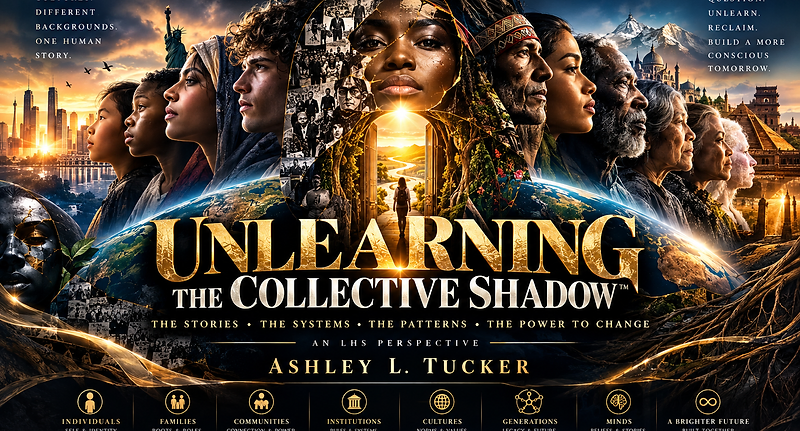
AN LHS LIVING SERIES
Unlearning the Collective Shadow™
The Stories We Inherit Before We Learn to Question Them
A 36-volume living series that follows inherited scripts across the whole lifespan — from before memory to the legacy we leave — and asks one question at every stage: what did I learn to believe before I could examine it?
Ashley L. Tucker · 36 volumes · 396 chapters · 108 case files
SERIES IDENTITY
Charcoal archives, aged gold, fractured glass
Deliberately distinct from The Sovereign Self: charcoal-and-aged-gold archive tones, fractured-glass geometry and thread/root line-work instead of the Sovereign Self palette and portal imagery.
ONE CONNECTED LENS
Every volume walks the same eleven steps
An original LHS framework describing how a harmful pattern travels — not as an infection, but as an inheritance — through individuals, relationships, families, institutions, networks, communities, technologies and generations. LHS-GHP is a social and interpretive framework. It deliberately does not model harm as a contagious disease and makes no epidemiological claim.
Your journey · Visitor
0 chapters read · 0 volumes started · 0 audits written · 0 lab contributions
Start with Volume 1 — UNLEARNING THE COLLECTIVE SHADOWACT I · THE INHERITED SHADOW
What arrives before memory, before language, before choice. · volumes 1–6

UNLEARNING THE COLLECTIVE SHADOW
The Stories We Inherit Before We Learn to Question Them

THE SHADOW BEFORE MEMORY
What We Inherit Before We Can Name It
THE SCRIPTED CHILD
Who We Become Before We Choose Who We Are
THE CHILD WHO LEARNED TO PERFORM
When Survival Becomes an Identity
THE ADOLESCENT MIRROR
Who Are You When Everyone Is Watching?
THE FIRST REBELLION
When Becoming Yourself Looks Like Disobedience
ACT II · THE SCRIPTS OF IDENTITY
The stories that tell us who we are supposed to be. · volumes 7–12

THE EMERGING SELF
Becoming an Adult Inside Other People’s Expectations
THE LOVE SCRIPT
Who Taught You What Love Is Supposed to Look Like?
THE FAMILY SHADOW
What Families Pass Down Without Saying
THE LOYALTY TRAP
When Belonging Requires Silence
THE GENDERED SCRIPT
Who Decided What You Were Supposed to Be?
THE BODY SCRIPT
Who Taught You How to Feel About Your Own Body?
ACT III · THE STRUCTURES OF BELONGING
Race, class, work, money, school, faith — the scripts we live inside. · volumes 13–18
THE RACE SCRIPT
How Historical Narratives Become Present Identity
THE CLASS SCRIPT
When Society Turns Circumstance Into Identity
THE WORK SCRIPT
When Your Occupation Becomes Your Identity
THE MONEY SHADOW
The Financial Stories We Inherit
THE EDUCATION SCRIPT
What School Teaches Beyond the Curriculum
THE RELIGIOUS SCRIPT
Faith, Inheritance, Authority, and Identity
ACT IV · THE MACHINERY OF REINFORCEMENT
Culture, media, algorithms, institutions, authority, silence. · volumes 19–24
THE CULTURAL CODE
The Rules We Call Normal
THE MEDIA MIRROR
Who Benefits From the Stories We Repeatedly See?
THE DIGITAL SELF
Who Are You When the Algorithm Is Watching?
THE INSTITUTIONAL SHADOW
When Systems Teach People How to Behave
THE AUTHORITY SCRIPT
Why We Obey What We Never Examine
THE BYSTANDER SHADOW
What Happens When Everyone Sees It but Nobody Acts?
ACT V · TRANSMISSION AND COLLECTIVE MEMORY
How stories travel between people, generations and places. · volumes 25–30
THE DECEPTION CHAIN
How Stories Travel From Person to Person to Generation
THE COLLECTIVE MEMORY
What Humanity Remembers—and What It Forgets
THE SHADOW OF AGING
Who Decides Who You Become Later in Life?
THE END-OF-LIFE SCRIPT
What We Believe About Death, Dignity, and Legacy
THE INTERGENERATIONAL SHADOW
What One Generation Leaves for the Next
THE COMMUNITY SHADOW
When a Neighborhood Inherits a Story
ACT VI · UNLEARNING AND RECONSTRUCTION
Naming the whole system, then building what comes after it. · volumes 31–36
THE SYSTEMIC SHADOW
When Nobody Has to Plan the Pattern for It to Continue
THE SHADOW ECONOMY OF IDENTITY
When Human Worth Becomes a Marketplace
THE TRUTH RECLAMATION
Learning to Separate Reality From the Script
THE UNLEARNING PRACTICE
How to Question What Once Felt Certain
THE COLLECTIVE RECLAMATION
How Communities Unlearn Together
BEYOND THE SHADOW
Building a Future We Do Not Have to Unlearn


THE SECOND LAYER
The Hybrid Interactive Series™
The living companion layer: every volume carries an interactive hybrid edition with claim inspection, script mapping and reader annotation.
Every volume is a living node: read it, challenge it, extend it, and watch the research update.
Series knowledge graph
592 nodes and 1366 edges connecting volumes, chapters, scripts, case files, age ranges, identities, institutions, historical records, transmission mechanisms, impacts, counter-scripts and open questions.
Added as a new graph for this series only — no existing knowledge graph is touched.
Research integrity engine
Every volume is scanned for nine conditions before publication. Flags are advisory — no published text is ever rewritten automatically. Volumes currently carrying a flag: 1, 2, 3, 4, 5, 6, 7, 8, 9, 10, 11, 12, 13, 14, 15, 16, 17, 18, 19, 20, 21, 22, 23, 24, 25, 26, 27, 28, 29, 30, 31, 32, 33, 34, 35, 36.
Research integrity — series totals
Future Volume Queue
12 proposed volumes identified by coverage gap. Adding one is additive by rule: a queued volume never replaces an existing volume, and every proposal carries its gap, reason, questions, lens, related volumes, age groups, populations and estimated length.
PROPOSED VOL. 37proposedTHE DISABILITY SCRIPT
Disability appears across the core volumes as a population affected by other scripts, but no volume follows ableism itself as an inherited script — from medical-model language to accessibility defaults.
Reason: Accessibility is designed or omitted upstream of every other script in this series; without this volume the series describes disabled people rather than the script that surrounds them.
Research questions
- · How did the medical model of disability become the default language of institutions?
- · What does an accessible household look like across the lifespan?
- · How does the series itself need to change to include disabled readers fully?
LHS lens: Shadow (medical model) → Script (worthy of pity or cure) → Origin (institutional charity law) → Transmission (clinic, school, workplace) → Reinforcement (accessibility defaults) → Internalisation (self-definition through limitation) → Impact → Recognition → Unlearning → Reclamation → Reconstruction (access as design, not favour).
Related volumes: 12, 17, 22, 27
Target age groups: all ages
Target populations: disabled people, carers, educators, employers, policy designers
Estimated length: 50 pages
PROPOSED VOL. 38proposedTHE INTERSEX AND DONOR-CONCEIVED SELF
Volume 11 covers gendered assignment and Volume 29 covers descendants, but neither follows people whose origin records were decided, sealed or altered by others.
Reason: Sealed records and early medical decisions are an inheritance imposed rather than transmitted, which is a distinct mechanism of the shadow.
Research questions
- · What does a person owe a record they were never allowed to read?
- · How do sealed origins shape identity across the lifespan?
- · What does honest institutional practice look like for amended records?
LHS lens: Shadow (imposed record) → Script (protective silence) → Origin (statutory sealing and clinical protocol) → Transmission (archive, family practice) → Reinforcement (administrative default) → Internalisation → Impact → Recognition → Unlearning → Reclamation → Reconstruction (open records, consent-based practice).
Related volumes: 2, 11, 29
Target age groups: all ages
Target populations: intersex people, donor-conceived people, adoptive families, clinicians, registrars
Estimated length: 50 pages
PROPOSED VOL. 39proposedTHE INCARCERATION INHERITANCE
Volume 22 examines institutions and Volume 29 inheritance, but the family consequence of imprisonment — visiting rooms, sentence scripts, children of prisoners — is not given its own volume.
Reason: Punishment is the clearest case of a state decision becoming a family inheritance, and it is under-recorded as such.
Research questions
- · How do children of imprisoned parents inherit the sentence?
- · What does prison visiting teach a family about itself?
- · Which records make the inheritance visible?
LHS lens: Shadow (sentence) → Script (deserved punishment) → Origin (penal statute) → Transmission (visiting room, school forms, address history) → Reinforcement (custody, employment screening) → Internalisation → Impact → Recognition → Unlearning → Reclamation → Reconstruction (family-centred sentencing transparency).
Related volumes: 22, 24, 29
Target age groups: 0–70+
Target populations: children of imprisoned parents, partners, prison staff, formerly incarcerated people
Estimated length: 50 pages
PROPOSED VOL. 40proposedTHE SERVICE FAMILY SCRIPT
Volume 4 covers the performing child and Volume 23 covers authority, but military and emergency-service households — where the script is formal and honoured — are not examined directly.
Reason: A respected script is harder to examine than a shamed one, and this series must be able to examine honoured inheritance too.
Research questions
- · What does a service household transmit about duty, silence and danger?
- · How are children taught to carry a role they did not choose?
- · What does a veteran family need in order to speak?
LHS lens: Shadow (duty as identity) → Script (service first) → Origin (military and emergency institutional culture) → Transmission (relocation, deployment, family myth) → Reinforcement (honour and necessity) → Internalisation → Impact → Recognition → Unlearning → Reclamation → Reconstruction (duty without erasure).
Related volumes: 4, 18, 23
Target age groups: all ages
Target populations: service families, veterans, first responders, military children
Estimated length: 50 pages
PROPOSED VOL. 41proposedTHE DISPLACEMENT SCRIPT
Volume 19 covers cultural codes and Volume 9 family silence, but forced displacement — camps, host-country expectation, waiting status — deserves its own volume.
Reason: Displacement combines every mechanism in this series at once: record loss, imposed identity, administrative waiting and inherited obligation.
Research questions
- · What does a decade of waiting status teach a family?
- · How is identity assigned by a host system?
- · What records does displacement destroy that cannot be reconstructed?
LHS lens: Shadow (displacement) → Script (temporary) → Origin (conflict, climate, policy) → Transmission (household, camp, host community) → Reinforcement (status law, labour permit) → Internalisation → Impact → Recognition → Unlearning → Reclamation → Reconstruction (status transparency, community memory).
Related volumes: 9, 19, 26
Target age groups: all ages
Target populations: refugees, internally displaced people, asylum seekers, host communities
Estimated length: 50 pages
PROPOSED VOL. 42proposedTHE CARE ECONOMY SCRIPT
Volume 15 covers work and Volume 27 aging, but the paid care economy — who provides care, at what wage, and what it costs them — is only implied.
Reason: Care is the largest scripted labour system in most societies and is almost entirely absent from its own record.
Research questions
- · Who has been assigned care work, and how was that decided?
- · What happens to the carer after the person they cared for dies?
- · How should care work be recorded and paid?
LHS lens: Shadow (care as duty) → Script (women's work, family responsibility) → Origin (labour policy and household expectations) → Transmission (family, migration chains) → Reinforcement (wage levels, licensing) → Internalisation → Impact → Recognition → Unlearning → Reclamation → Reconstruction (care as recognised work).
Related volumes: 11, 15, 27
Target age groups: 18–85
Target populations: paid and unpaid carers, domestic workers, migrant care workers, families
Estimated length: 50 pages
PROPOSED VOL. 43proposedTHE CLIMATE INHERITANCE
No core volume follows the environment as a script: how a generation is handed an altered place, and a set of expectations about who pays for it.
Reason: The clearest present example of an unchosen inheritance is a changed climate and the obligation attached to it.
Research questions
- · What is being handed to children as an obligation?
- · How are communities told to adapt and told to blame themselves?
- · What does intergenerational fairness look like in practice?
LHS lens: Shadow (altered place) → Script (progress, growth, blame) → Origin (industrial policy record) → Transmission (household, school, insurance, planning) → Reinforcement (markets, subsidies) → Internalisation → Impact → Recognition → Unlearning → Reclamation → Reconstruction (planned adaptation and honest accounting).
Related volumes: 29, 30, 31
Target age groups: all ages
Target populations: coastal and agricultural communities, young people, municipal planners
Estimated length: 50 pages
PROPOSED VOL. 44proposedTHE LANGUAGE AND ACCENT SCRIPT
Volumes 14 and 19 touch accent and code, but the script of language — whose speech is credible, whose is corrected — has no volume of its own.
Reason: Language is the most efficient carrier of class, race and migration scripts, and it is measurable in school and hiring records.
Research questions
- · What does corrective instruction teach a child about their own voice?
- · How do accent judgements survive in hiring?
- · What is lost when a language stops being spoken at home?
LHS lens: Shadow (voice) → Script (correct speech) → Origin (schooling and standardisation) → Transmission (school, workplace, media) → Reinforcement (assessment and hiring) → Internalisation → Impact → Recognition → Unlearning → Reclamation → Reconstruction (linguistic dignity).
Related volumes: 13, 14, 19
Target age groups: 4–70
Target populations: bilingual and dialect-speaking communities, migrants, pupils judged by accent
Estimated length: 50 pages
PROPOSED VOL. 45proposedTHE AI GUARDIANSHIP SCRIPT
Volume 21 covers the algorithmic self, but not machine judgement over a person's access, care or eligibility, nor what it means for a household to be scored.
Reason: Automated decisions transfer authority from a person to a system in a way this series must be able to describe and challenge.
Research questions
- · What happens to appeal when nobody owns the decision?
- · How should a household audit a score that governs it?
- · Which documented failures define current practice?
LHS lens: Shadow (score) → Script (objective system) → Origin (eligibility automation) → Transmission (insurer, lender, agency, school) → Reinforcement (procurement, opacity) → Internalisation → Impact → Recognition → Unlearning → Reclamation → Reconstruction (contestable decisions, published thresholds).
Related volumes: 21, 22, 32
Target age groups: 16+
Target populations: benefit claimants, borrowers, patients, public-sector staff
Estimated length: 50 pages
PROPOSED VOL. 46proposedTHE INSTITUTIONAL APOLOGY
Volume 26 covers collective memory and Volume 25 the deception chain, but neither examines what an apology does after it is issued.
Reason: Repair is the outcome the whole series points toward, and the record of apologies that changed nothing is the most instructive evidence available.
Research questions
- · What distinguishes an apology that repairs from one that closes a file?
- · What must be recorded for repair to be verifiable?
- · Who measures whether anything changed?
LHS lens: Shadow (harm) → Script (it is closed now) → Origin (the official statement) → Transmission (press, curriculum, institutional memory) → Reinforcement (absence of measurement) → Internalisation → Impact → Recognition → Unlearning → Reclamation → Reconstruction (published commitments with dates).
Related volumes: 25, 26, 35
Target age groups: all ages
Target populations: affected communities, institutional leaders, historians, journalists
Estimated length: 50 pages
PROPOSED VOL. 47proposedTHE RETURN MIGRATION SCRIPT
Volume 29 covers inheritance and Volume 19 culture, but the script of return — going back to a homeland that changed without you — is unexamined.
Reason: Return is where an inherited story meets the place that wrote it, and the collision is documented in family records and community accounts.
Research questions
- · What is a returnee expected to already be?
- · How do second-generation returnees inherit a belonging they did not earn?
- · Which records help a family place itself?
LHS lens: Shadow (belonging) → Script (go home) → Origin (family migration decision) → Transmission (family story, language expectation) → Reinforcement (community judgement) → Internalisation → Impact → Recognition → Unlearning → Reclamation → Reconstruction (belonging chosen and stated).
Related volumes: 19, 29, 30
Target age groups: all ages
Target populations: second-generation returnees, diaspora families, receiving communities
Estimated length: 50 pages
PROPOSED VOL. 48proposedTHE FORGIVENESS SCRIPT
The series ends with reconstruction, but never examines the demand that people forgive — and who benefits when a harmed person is asked to move on.
Reason: Forgiveness is routinely scripted onto the harmed person, which makes it the last inherited instruction the series has to open.
Research questions
- · Who benefits when forgiveness is required?
- · What is the difference between peace and resolution?
- · Can a community set terms for repair without scripting the wronged?
LHS lens: Shadow (harm) → Script (turn the page) → Origin (religious and institutional convention) → Transmission (family, congregation, workplace) → Reinforcement (closure demanded by the offender's community) → Internalisation → Impact → Recognition → Unlearning → Reclamation → Reconstruction (chosen peace, stated terms).
Related volumes: 10, 18, 36
Target age groups: 16+
Target populations: people harmed, families in conflict, restorative-practice facilitators
Estimated length: 50 pages
The author's desk
The review queue for every contribution to this series, the integrity report, the living-update log and the future volume queue.
Open the deskUnlearning the Collective Shadow™ · Ashley L. Tucker · built as a new additive layer. No existing book, series, record, page or integration was modified to create it.